2020
Operation Warp Speed: mRNA Vaccines
operation-warp-speed-mrna-vaccines
2012
CAR-T Cell Therapy
car-t-cell-therapy
2003
PEPFAR
pepfar
2003
Human Genome Project
human-genome-project
1988
Laparoscopy
laparoscopy
1987
Statins
statins
1980
MRI
mri
1977
PET Scan
pet-scan
1977
Global Eradication of Smallpox
global-eradication-of-smallpox
1976
Genentech & the Birth of Biotech
genentech-the-birth-of-biotech
1973
Telemedicine
telemedicine
1967
Coronary Bypass Surgery
coronary-bypass-surgery
1961
Framingham Heart Study
framingham-heart-study
1955
The Polio Vaccine
the-polio-vaccine
1954
Kidney Transplant
kidney-transplant
1952
Eternal Pacemaker
eternal-pacemaker
1944
Penicillin Scale-Up
penicillin-scale-up
1944
DNA vs. Protein
dna-vs-protein
1937
Blood Banking, A System for Stored Lifesaving
blood-banking-a-system-for-stored-lifesaving
1923
Insulin Mass Production
insulin-mass-production
1862
The Civil War Ambulance Corps and Birth of the Modern EMS
the-civil-war-ambulance-corps-and-birth-of-the-modern-ems
1846
Ether Anesthesia
ether-anesthesia
1820
Establishing Pharmacopeia
establishing-pharmacopeia
1777
Smallpox Inoculation
smallpox-inoculation
1751
Pennsylvania Hospital
pennsylvania-hospital

1954

Kidney Transplant

American innovation has long been obsessed with the idea of interchangeable parts. It’s what allowed Eli Whitney to revolutionize manufacturing and Henry Ford to scale the assembly line. But for decades, that logic hit a hard wall at the human body.

We could swap a spark plug, but we couldn't swap an organ. Surgeons had been testing transplants as early as 1902, even trying xenotransplantation (using organs from different species like pigs). The result was always the same: even if the surgical plumbing was perfect, the body’s immune system would identify and destroy the new part within days.

In 1954, a team in Boston finally found a loophole in the biology of identity that allowed us to treat a human organ as a replaceable part.
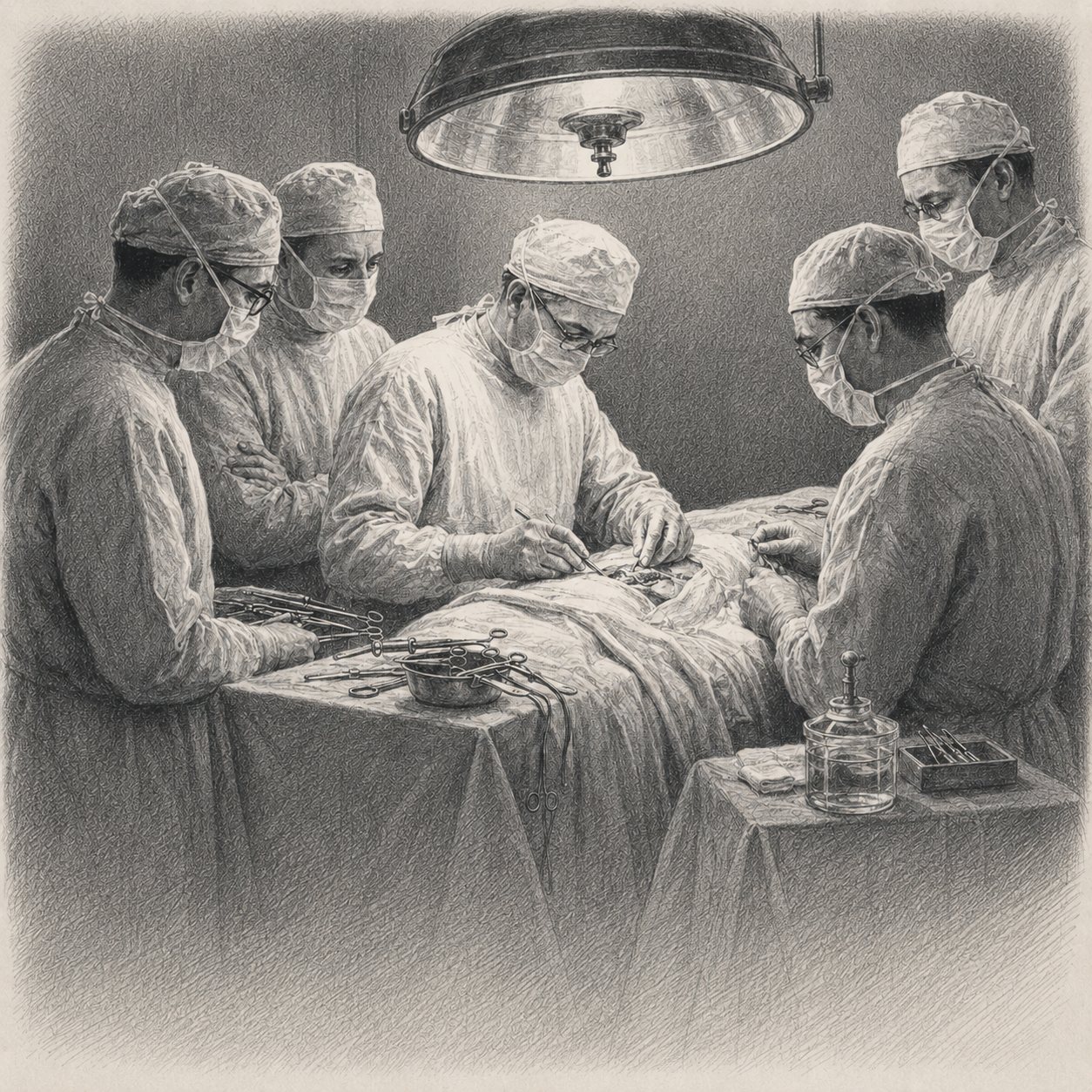
Richard Herrick receives the first successful organ transplant in history at Peter Bent Brigham Hospital.

  • Stymied
    Stymied. Since the early 1900s, surgeons like Alexis Carrel had mastered the technique of sewing blood vessels together, but every transplant failed because the recipient's immune system rejected the foreign tissue.
  • The Hypothesis
    Dr. Joseph Murray hypothesized that the only way to bypass rejection without the use of drugs (which didn't exist yet) was to find a donor with an identical genetic makeup.
  • Loophole
    Richard Herrick was dying of kidney failure. His brother, Ronald, was his identical twin. Because they shared the same DNA, their biological signatures were a perfect match.
  • Exchange
    On December 23, 1954, the team moved a healthy kidney from Ronald to Richard. The new part began functioning immediately upon being connected to Richard's circulatory system.
  • Legacy
    The Herricks proved that human organs could function as "interchangeable parts" if the immune system was navigated correctly. Richard lived for eight more years, and Ronald lived to be 79.

From Brian

This breakthrough was a critical link in a long chain, but it was only the first step. By using twins, Murray’s team essentially cheated the immune system to prove that the surgical mechanics of transplantation actually worked. It provided the baseline proof of concept the medical community needed to stop guessing and start building.

With the surgical problem solved, doctors were put on a path to rapidly work through the methods to avoid rejection in the general population. This success led directly to the 1960s, when the development of the first immunosuppressant drugs (like azathioprine) finally allowed us to perform transplants between non-twins.

The surgery also established a new ethical framework for medicine. For the first time, a healthy person was put on an operating table for the benefit of another. This established the modern protocols for living donation and informed consent that we still use today.

Read On LinkedIn